As I listen to this the book recommendation from Sammi’s dad, “Outlive,” by Peter Attia, you document its lessons.
One: Heart Health
“Apo-B” is a test you can have run from bloodwork at your doctor’s. This panel shows you how many “carriers” of cholesterol are in your bloodstream.
It is not cholesterol that is the issue but the misplacement and spillage of cholesterol. The higher your Apo-B, the greater odds you have of spilling cholesterol into your arteries instead of it being delivered to your liver and muscles. It’s this spillage of cholesterol that leads to plaque, clot, and eventually heart attack.
LP-a.
LDL-c (in concentration, or the measurement taken from tests) can and should be as low as possible. 10 mg per deciliter or less despite current recommendations as high as 70-100 mg. Remember, babies have close to 0 in the bloodstream at any one time yet are able to use cholesterol for rapid growth.
Statins are one drug you can take to remove Apo-B. Apo-B is the causal link to high cholesterol. The recommended statin is resuvastatin, brand name kressler.
PC6-K9 inhibitors in addition to statins will reduce LP-a as well. Do you take these? For how long? What dosage? These are the questions left unanswered.
Furthermore, what diet is helpful in support of this?
Two: Fasting
Mammals that are nutrient deficient have higher protection against disease and live longer in lab settings by 15%. However, labs are free of germs. Thus, it is likely not best to live nutrient deficient, but this does support long-term fasting to allow for cell autophagy, the self-eating and cleansing of cells where instead of making new cell materials, cells recycle old cell materials, clearing out the total materials in the body.
The suggestion is to find balance between entering states of caloric deficiency as a cleansing period while eating sufficiently during normal times to not be anemic or gaunt. Curiously, Yogananda and others recommend fasting for one day each week as a reset for the body and mind.
Three: Cancer
Cancer’s metabolism uses the higher glucose fed, anaerobic processes that creates lactic acid and other cellular building blocks. Its output creates an acidic environment that reduces the immune systems ability to navigate.
Metabolic improvements by reducing insulin levels can decrease a cancer’s ability to eat and grow.
Four
Apo-E gene testing. E2, E3 genes (among others) are a bio markers that puts you in higher risk for Alzheimer’s.
Five: Sugar
Think of your body’s ability to absorb sugar via insulin as a bathtub. The more fat you have, the larger your tub. If you exceed that tub, more insulin must be released in your systems straining the insulin glands and eventually creating insulin resistance. It’s not necessarily that sugar is bad, but that sugar in overload, which can more easily occur from sugary drinks and processed added sugar, damages your body’s glucose system.
You will have to see for yourself how your blood sugar reacts to the eating of fruit (which Yogananda says is the most important food to eat).
Six: Exercise
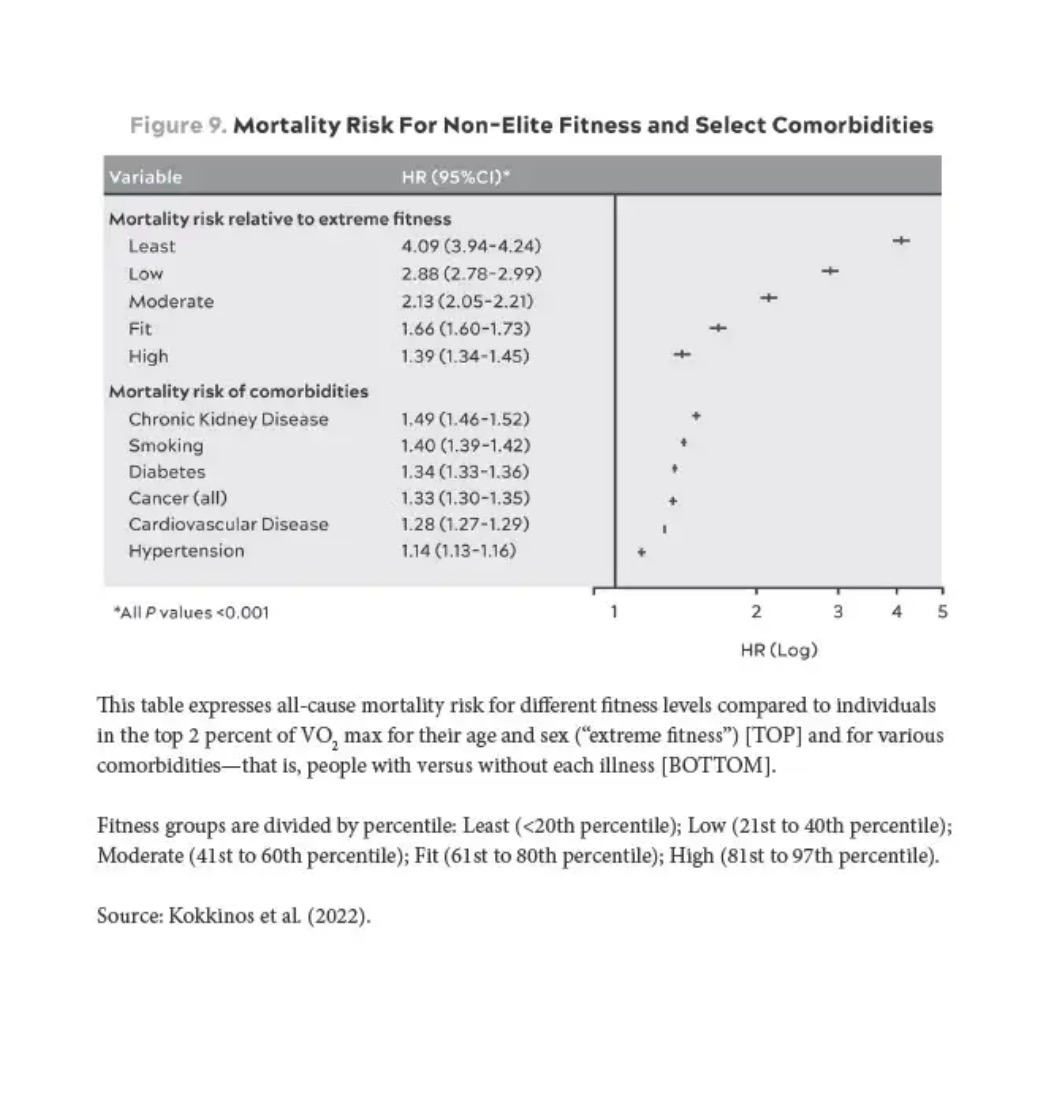
Exercise is the single greatest influencer of our health and longevity. It comprises aerobic health, strength, and mobility. There is no substitute.
The minimum is 150 minutes of high intensity aerobic training, and another 90 minutes of strength and fitness training. … {details to come.}
It’s not about muscle mass, but one’s ability to move weight.
Seven: How to Aerobic
The majority of our mitochondria efficiency will come from building endurance while we are in Zone 2 of our effort/power output. Not too high, creating too much lactic acid, which uses glucose and is more anaerobic and produces an acidic environment for the body, but also not too easy which does not build endurance.
Aim for a workout that you can complete while talking, but with shortness of breath. If you can’t talk, that’s too hard. If you can talk, that’s too easy. Modern heart rate monitors will also track this. Of course, the only actual measurement is with a hand held lactic acid tracker, that requires an active blood draw.
Eight: VO2 Max
Once a week complete a workout focused on VO2 Max. This is a workout of intervals, spending 4 minutes at the upper limits of what you can handle, then four minutes of rest (walking), and repeating this four to five times.
The key is that you push yourself at for the four minutes while being able to recover fully in between sets.
Nine: Strength Building
You want strength first as grip strength, then concentric and deconcentric (away from you and towards you), and to do these motions at controlled speed. Swiftly. Think fast-twitch strength.
The recommendations are rucking, pull-ups, the farmer’s carry (carrying large dumbbells to the sides of you, working your way up to your body weight split, half on either side), squats, and deadlifts.
Maximizing our ability to carry heavy things is the focus.
Ten: Reverse Engineering
We will lose 10% of our current VO2 and strength capacity each decade after 40, and 15% each decade after 65 without intervention. Ask yourself from his list of centenarian decathlon activities what you still want to be able to do. At 80, 90, 100 do you still want to go on a walk by yourself, board a plane and stow away your luggage, pick up your grandchildren … to do this then, you need to be able to do 4 times that now.